Chemical reactivity modified by strong coupling

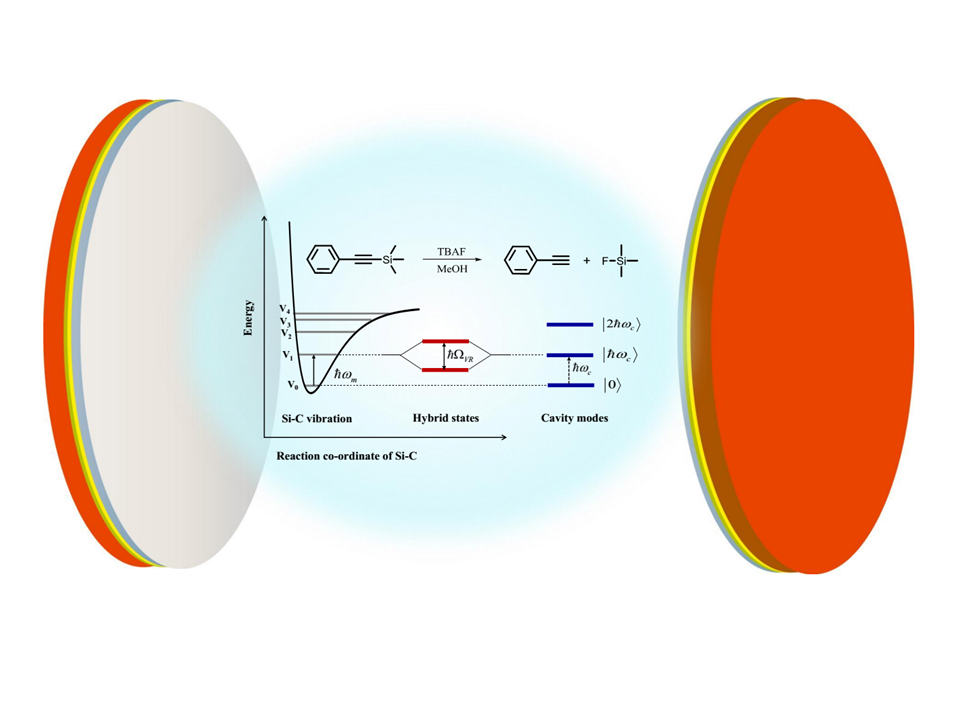
A fruitful collaboration between our group and Josef Moran team at ISIS revealed another very promising aspect of strong coupling : we proved indeed that one can modify a chemical reaction by strongly coupling a vibrational mode of the reactant. The reaction slows down significantly and the relative change in the reaction rate under strong coupling depends on the Rabi splitting energy.
TOC 4


The work had been published in Angewandte Chemie and you can read it here or download it from our publications page.
Strong coupling of a 2D material

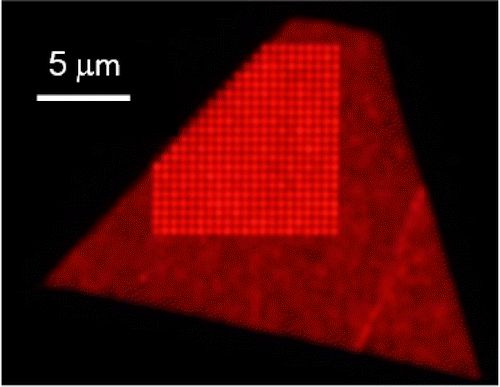
Wa are glad to announce a coming publication in Nano Letters (to be downloaded here), resulting from a collaboration between our group and Paolo Samori’s group. Room temperature strong coupling of WS2 monolayer exciton transitions to metallic Fabry–Pérot and plasmonic optical cavities is demonstrated, suggesting many possibilities for combining light–matter hybridization with spin and valleytronics

nl-2016-01475g_0005


Non radiative energy transfer mediated by strong-coupling

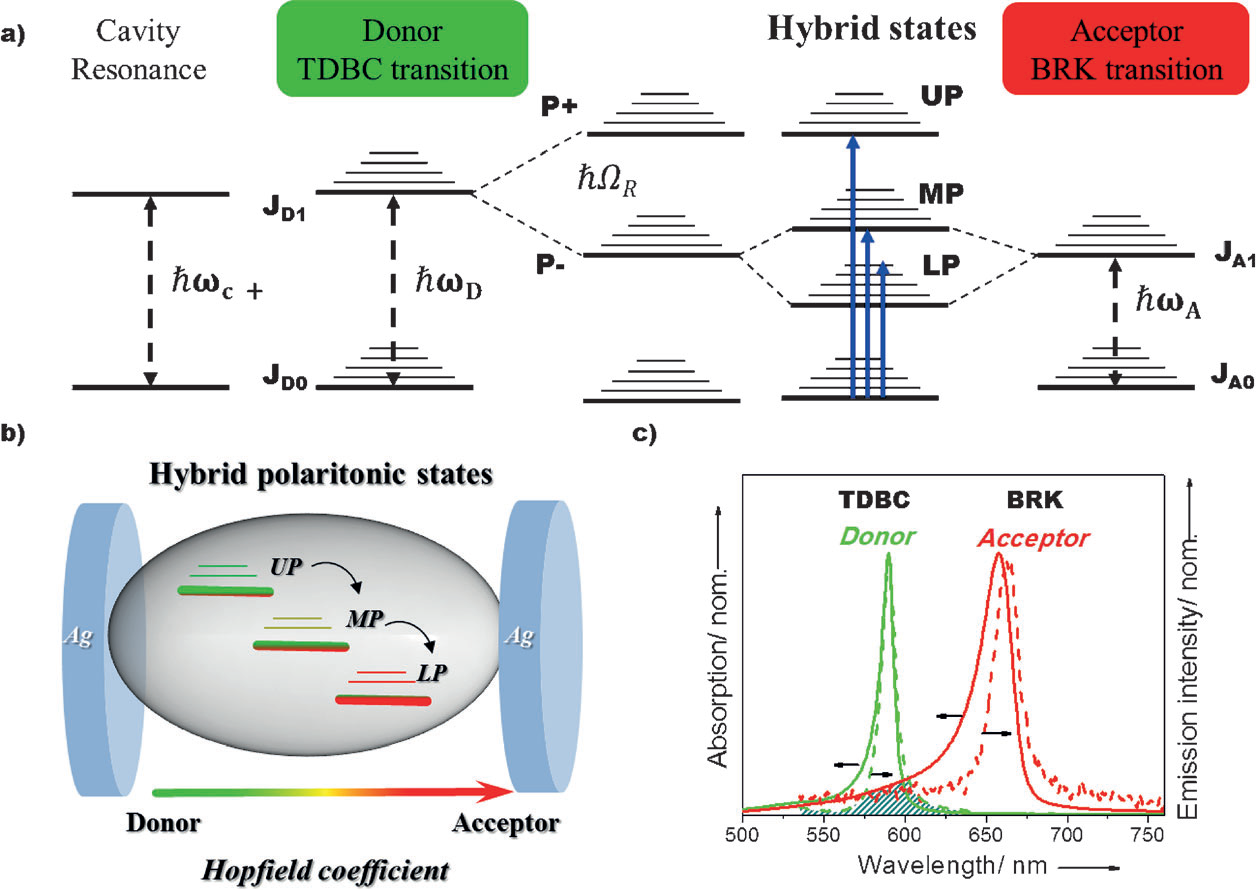
We recently demonstrated evidence of non-radiative energy transfer mediated and boosted by the polaritonic states under the regime of strong coupling. When the donor and acceptor molecules are placed in a cavity, to form hybrid light-matter states with the vacuum field, the rate of energy transfer is multiplied by a factor of 7 compared to the situation outside the cavity. This work has just been published in Angewandte Chemie and you can read it here


energytransfer

A publication in Nature Materials

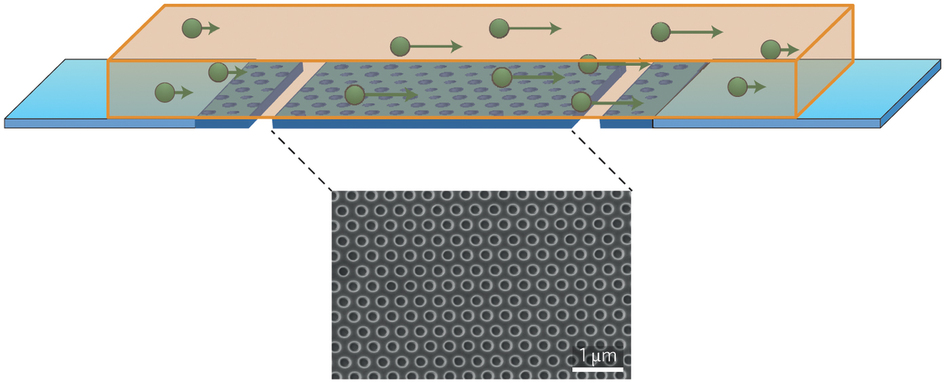
Our paper entitled Conductivity in organic semiconductors hybridized with the vacuum field has been published online in Nature Materials yesterday. We show that one can enhance the mobility of carriers, and thus the conductivity, in organic semiconductors, by placing them under the strong coupling regime.

A News and Views in the same edition is also highlighting our work. Congratulations to all our co-workers !

nmat4420-f1